Nexus— Enterprise Network Infrastructure Design and Implementation
Design and implementation of a structured enterprise network using Cisco Packet Tracer, featuring departmental VLANs, inter-VLAN routing and centralised network services.
About this project
# Operation Nexus — Enterprise Network Infrastructure Design and Implementation
## Project Overview
Operation Nexus is a practical enterprise networking project developed in Cisco Packet Tracer to simulate the design, configuration and administration of a structured enterprise network.
The project demonstrates how multiple departments within an organisation can communicate securely and efficiently through a centrally managed network infrastructure. It focuses on implementing core enterprise networking concepts, including network segmentation, IPv4 addressing, inter-VLAN routing, centralised network services, and network administration.
The objective was to move beyond basic connectivity exercises and build an integrated network environment that reflects the architecture and operational requirements of a real-world organisation.
## Network Architecture
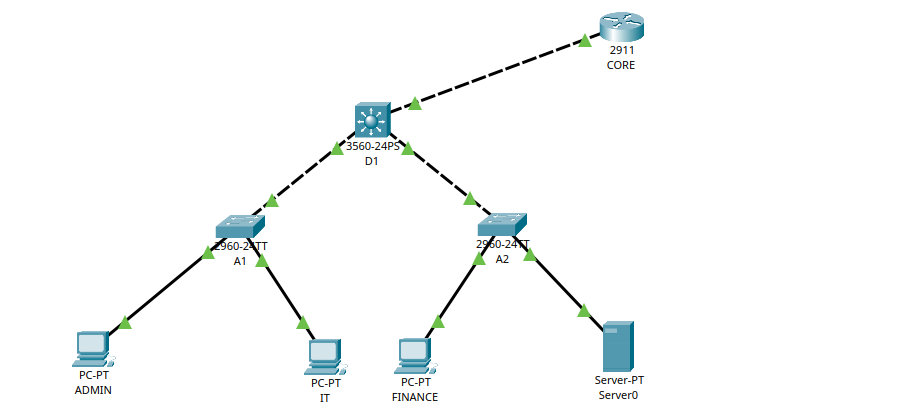
The simulated network uses a hierarchical enterprise network design consisting of:
- Cisco 2911 Edge Router: Provides the connection between the internal enterprise network and external networks.
- Cisco 3560 Multilayer Switch: Acts as the distribution layer, providing inter-VLAN routing and Layer 3 connectivity.
- Two Cisco 2960 Access Switches: Connect end-user devices and the server to the network.
- Centralised Server: Provides network services, including DHCP and DNS.
- End-user devices: Represent users from the Administration, IT and Finance departments.
## Key Technologies and Concepts
The project incorporates the following networking concepts:
- VLANs: Segmentation of the network into separate logical departments, including Administration, IT, Finance, Servers and Management.
- IPv4 Subnetting and VLSM: Structured IP address allocation to different network segments.
- Inter-VLAN Routing: Layer 3 routing between departmental networks using a multilayer switch.
- 802.1Q Trunking: Carrying multiple VLANs across switch-to-switch links.
- DHCP: Centralised automatic IP address allocation, including DHCP relay using `ip helper-address`.
- DNS: Internal hostname resolution through centrally managed DNS records.
- Static Routing: Configuring routing paths between the distribution switch and edge router.
- Enterprise Network Administration: Device configuration, interface management, connectivity verification and troubleshooting.
## Implementation and Testing
The network was implemented incrementally, beginning with physical topology construction and IP addressing, followed by VLAN configuration, trunking, routing and centralised services.
Connectivity was verified through end-to-end testing, including inter-VLAN communication, DHCP address assignment, DNS resolution and gateway reachability.
The project also involved identifying and correcting configuration and connectivity issues during implementation.
## Project Outcome
Operation Nexus demonstrates practical knowledge of enterprise network design, Cisco device configuration, IPv4 addressing, network segmentation, routing and infrastructure troubleshooting.
It provides a foundation for understanding how enterprise networks are structured, how network services support business operations, and how different infrastructure components work together to provide reliable connectivity.
Project Status: Completed
Platform: Cisco Packet Tracer
Project Category: Enterprise Networking / Network Infrastructure
Focus: Network Design, Configuration, Routing, Network Services and Troubleshooting